God I Trust You‐–All You Can Do Is Pray

When the One You Love Is Hospitalized

Forty years. More than four decades of holding hands through every chapter of life—raising children, building careers, weathering storms, laughing until tears fell, and learning from each other in ways no one else ever could. After that much time with someone, they become more than a spouse. They are your rhythm, your safe place, your steady.

And then suddenly…they’re in a hospital bed. And all the strength they’ve shown for years seems a world away.

For so long, I watched him work 16-hour shifts, 7 days a week. I saw him stand strong, provide, protect, and pour himself out without complaint. He was dependable, resilient, unshakable—my earthly rock. And now, in this new season of retirement—when we thought we’d be enjoying rest, travel, peace, and quiet—we’re facing battles we never saw coming. Spiritual attacks. Physical attacks on his body. Weakness where there used to be strength.

And the truth is…
It does something to your heart.

The Thoughts No One Wants to Admit

When your spouse is hospitalized, your mind becomes a battlefield.

What if he doesn’t recover the same?
What if this is the beginning of another long fight?
Will he be okay?
Will I have the strength to care for him the way he cared for us for so long?
Will God give us more time together?

No matter how old we get, no matter how many anniversaries we’ve celebrated…
It’s never enough time.
Not when you love someone this deeply.

You start replaying memories—young love, early mornings, late-night talks, road trips, holidays, the moments that shaped your life together. You start holding his hand tighter, noticing the warmth, the pulse, the gift of breath. And in the quiet moments between doctor visits and lab results, there’s a whisper in your spirit: “Lord, I trust You. Even in this.”

When Faith Becomes More Than Words

It’s easy to say “God is good” when everything is steady. It’s different when fear presses on your chest in a hospital room.

But this is exactly where faith becomes real.
Where trust becomes a choice.
Where love becomes deeper than comfort.

Psalm 73:26 reminds us:
“My flesh and my heart may fail, but God is the strength of my heart and my portion forever.”

Even when bodies grow weak, God’s strength does not.
Even when our hearts break, His hands hold them together.

Choosing Trust in the Middle of the Unknown

I don’t know what tomorrow holds. I don’t know how long we will have together. I don’t know what this season will require from me—or from him.

But here’s what I do know:
God has been faithful for every one of these 40+ years.
He has walked with us through storms, disappointments, and miracles.
He carried us when we didn’t know how to move forward.
And I know—deep in my soul—that He is carrying us now.

So I choose trust:
Trust that God will strengthen his body.
Trust that God will equip me to care for him.
Trust that God is not finished with our story.
Trust that love is stronger than fear.
Trust that whatever time we have—whether it’s many more years or just one more precious day—God will be in the midst of it.

Still Standing on His Promises

In this season, I hold tightly to Isaiah 41:10:
*“Fear not, for I am with you; be not dismayed, for I am your God.
I will strengthen you, I will help you, I will uphold you with my righteous right hand

🦃 A Heartfelt Thank You, A Harvest of Gratitude, and Exciting New Horizons!

Dear Thrive by The Rising Muse community,

As the calendar turns to November and the warmth of the holiday season approaches, I want to pause, take a deep breath, and extend my deepest, most heartfelt gratitude to each and every one of you. You—my dedicated listeners, wonderful guests, and engaged community members—are the true heart of this passion project.

🙏 Harvesting Our Shared Growth

Thanksgiving is a time for reflection, and as I look back on this journey, I am truly humbled. Your invaluable support, your willingness to share your stories, and your open-mindedness have been the fertilizer that has helped this community truly thrive. Watching our community grow from a seed of an idea into a vibrant ecosystem of personal growth and shared experiences has warmed my heart more than words can say.

Together, we are not just listening to a podcast; we are cultivating a beautiful journey. We’re exploring challenging topics, celebrating small victories, and committing to showing up as our best selves. Thank you for making this space one of genuine connection, inspiration, and mutual respect.

🚀 Exciting News: Tune In Wherever You Are!

We believe that cultivating personal growth should be convenient and accessible, no matter where your journey takes you. That’s why I am absolutely thrilled to announce that Thrive by The Rising Muse is now available on the incredible App Reveel platform!

This means you can now seamlessly integrate our episodes into your life, whether you’re relaxing on the couch, traveling, or just needing a boost of inspiration:

  • 💻 Direct Online Viewing: You can watch and listen to every episode right from your browser. Click here
  • 📺 On Your TV: Simply search for us on your Roku or Fire TV Stick.
  • 📱 On The Go: Download the App Reel app on your iOS or Android device.

Even more exciting news: Stay tuned, because App Reveel will soon be the exclusive home for special, exclusive episodes of the podcast, providing you with even deeper dives and unique content just for our community! Think extended interviews, behind-the-scenes glimpses, and focused Q&A sessions.

The App is FREE!

➡️ How to Connect with The Rising Muse Today

Getting started is easy! Choose the path that works best for you:

  1. Click Here to Watch Online
  2. Download the App Reveel App on your favorite device (search “App Reel”).
  3. Search for “Thrive by The Rising Muse” in the app. Or look for the show under the Reality TV Category
  4. Tap the follow/subscribe button and start listening!

Thank you once again for being the most supportive, inspiring part of this endeavor. I look forward to continuing to share our experiences, celebrating our growth, and connecting with you across these new platforms!

Warmest wishes for a happy and meaningful Thanksgiving season,

Thrive by The Rising Muse

Legalizing the Gospel

This may not be a popular topic, but here we go.

In the last decade or so, I have seen a movement of Christians trying to put laws in place according to what the Bible says we should or should not do. I am a follower of Jesus, but this movement, in my opinion, has brought out several issues.

1. Politicians who pretend to be Christian just to obtain votes.
The Bible says, “You will recognize them by their fruits” (Matthew 7:16). However, in my observation, the masses are bending over backwards to justify some people’s behaviors, decisions, and actions just because their mouths have said they are Christians—even though their fruits are not showing.

2. Looking the other way.
I’ve also observed Christians compromising their own values just to have someone in office who will get things done the way they want, something like “the end justifies the means.”

Here’s my issue with Christianity by law: Are people realizing that forcing someone into a particular behavior does not mean they are accepting or living for Christ?

For example, you could mandate by law that all citizens attend church every Sunday. People might show up at their nearest church, but that doesn’t mean the message is going into their hearts.

God gave us free will. “Now the Lord is the Spirit, and where the Spirit of the Lord is, there is freedom” (2 Corinthians 3:17). Jesus never forced anyone to accept Him. Why are we? Jesus came to show us His unconditional love—a love that leads us to repentance and to fall in love with Him enough to follow Him to the ends of the earth.

When you force someone into submission, they don’t love what they’re doing—they resent it. They may outwardly show the “good” behavior you want to see, but their heart has not turned toward God.

Legislating Faith vs. Living Faith

Legislating faith is spiritual laziness. We are called to “go and make disciples of all nations” (Matthew 28:19), to witness what God has done in our lives, and to show His love through our actions. Instead, some want the government to force people to behave according to our beliefs so we can feel like we’ve accomplished something—when in reality, we have not.

We don’t want to do the hard work of loving everyone, forgiving everyone, and showing mercy to everyone. Instead, we often live with selective love for those who think, believe, and behave like we do. We exercise selective outrage toward those we judge, while ignoring the person in the mirror.

Should society be a free-for-all? No. But when we impose laws to force our faith on the masses, we are not pleasing God. We are not making disciples—we are making people who resent the gospel. And it’s not because of their hardened hearts, but because of our hypocrisy.

We appear hypocritical when we only address the sins of others but excuse the sins of those “within the faith.” “Why do you look at the speck in your brother’s eye and pay no attention to the plank in your own eye?” (Matthew 7:3).

When someone outside the church falls, we often respond with outrage. But when someone in our faith circle falls, we excuse it as a “moment of weakness.” That’s not mirroring Jesus—it’s hypocrisy.

The Call to Love

When someone doesn’t think like us, we dismiss them as evil, forgetting that God placed them in our path so we could witness to them and love them.

And yes, even love our enemies. “But I say to you, love your enemies and pray for those who persecute you” (Matthew 5:44).

So when I see people who claim to follow Christ spewing hate, it hurts my heart. Because we should know better. Did we forget where we were before Jesus rescued us? Did we forget that He forgave our sins—and continues to forgive them?

“For it is by grace you have been saved, through faith—and this is not from yourselves, it is the gift of God” (Ephesians 2:8-9).

If that’s true for us, then it is also true for those around us.

The Harvest Is Plentiful

The Word says, “The harvest is plentiful, but the laborers are few” (Luke 10:2). It is time to reflect on how our thoughts and behaviors are either drawing people to Jesus or pushing them away.

You may say you’ve tried and seen no results. But sometimes you’re only meant to plant the seed. Someone else waters, and another sees the fruit (1 Corinthians 3:6–7). But don’t miss your role as a planter.

I know it’s hard not to give up, but I can testify: I was a wreck, and God chased me relentlessly to show me His love. Even now, when I fall flat on my face, He picks me up, cleans me off, and sets me back on solid ground. He knows my flaws, yet He still uses me to reach people. He has assigned each of us to love and serve specific souls.

The Bottom Line

It is our job to show God’s love, grace, and mercy. It is not the government’s job to legislate Christianity, so we can feel good about forcing people into behaviors that don’t lead to salvation.

We don’t win souls by writing laws. We win them by living out the gospel.

#FaithOverPolitics #ChristianLiving #discipline

Back-to-School Blues: Navigating the Mental Health Challenges for Kids and Parents

The end of summer often brings a mix of emotions—excitement, nervousness, anticipation, and stress. As backpacks are packed, lunchboxes lined up, and school calendars pinned on the fridge, both kids and parents can find themselves overwhelmed by the transition. While back-to-school season marks a new chapter of growth and learning, it can also trigger anxiety, burnout, and emotional strain for the entire family.

Let’s talk honestly about the mental health challenges that come with this season and explore realistic strategies to support your family’s well-being.

The Emotional Toll on Kids

Children, especially those starting a new school, grade level, or even changing schools altogether, can experience:

  • Separation anxiety (especially in younger kids)
  • Academic pressure or performance anxiety
  • Social stress: fears of bullying, fitting in, or navigating friendships
  • Sensory overload from long days, crowded classrooms, and routine changes

These emotional strains can show up as:

  • Trouble sleeping or waking up
  • Stomachaches or headaches with no clear cause
  • Emotional outbursts or mood swings
  • Withdrawal or silence about school experiences

The Silent Stress of Parents

While trying to be the steady hand for their children, parents often carry:

  • Financial pressure from school supplies, clothing, or extracurriculars
  • Work-life balance strain—especially for working parents juggling drop-offs, pick-ups, and homework
  • Emotional burnout from worrying about their child’s well-being, performance, and happiness

Parents may not notice their own stress until it shows up as:

  • Irritability or emotional exhaustion
  • Sleeplessness or feeling “on edge”
  • Feelings of guilt or inadequacy

How to Ease the Mental Load: Strategies That Help

Whether you’re a parent, caregiver, or educator, here are some grounded strategies to help ease the back-to-school transition:

1. Normalize the Emotions

Let your child know that it’s okay to feel nervous, overwhelmed, or even sad about the return to school. Validate their feelings before jumping into solutions. Model the same honesty for yourself: “I’m feeling a little stressed too, and that’s okay.”

2. Create Consistent Routines

Structure helps reduce anxiety. Start transitioning to school-year routines a week or two early—especially sleep and meal times. A predictable rhythm brings security and calm for both kids and parents.

3. Schedule Mental Health Check-Ins

Make it a habit to check in emotionally with your child, even just 5–10 minutes after school, to ask open-ended questions:

  • “What was the best part of your day?”
  • “Was there anything today that felt tough?”

Do the same for yourself. Journal, pray, or talk with a trusted friend about your own emotional state.

4. Practice Calming Techniques Together

Incorporate deep breathing, morning affirmations, or quiet time into your routine. These small practices build resilience and teach emotional regulation.

5. Set Realistic Expectations

Back-to-school doesn’t have to be perfect. Focus on progress, not perfection. Celebrate small wins—like getting out the door on time, finishing a hard assignment, or trying something new.

6. Build in Joy

Plan small family traditions to look forward to—Friday night movie night, Saturday pancake breakfast, or mid-week dance breaks. These joyful moments help balance out the mental load.

7. Know When to Get Support

If stress, anxiety, or sadness lingers beyond the adjustment period, it’s okay to seek professional support. Therapy or counseling can offer tools for both children and parents to manage emotional wellness.

Remember: Transitions Take Time

The beginning of the school year is not just a logistical change—it’s an emotional one. Be gentle with your kids. Be gentle with yourself. Your mental well-being is just as important as getting to school on time.

Let’s prioritize emotional safety this school year as much as academic success. When our hearts are healthy, our minds learn best.

Let’s Thrive Together.

If this season has you feeling anxious or overwhelmed, you’re not alone—and you don’t have to carry it alone. Thrive by The Rising Muse is here to walk with you through real life, real emotions, and real growth.

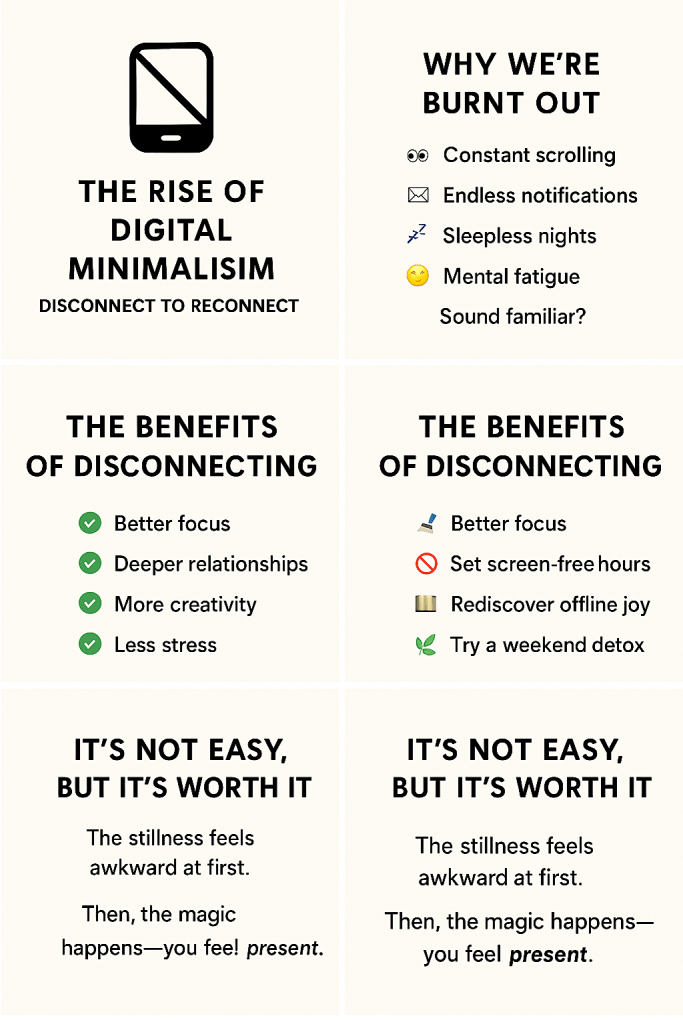
The Rise of Digital Minimalism: How Disconnecting Can Lead to More Meaningful Connections

Introduction:

Have you ever picked up your phone to check one thing, then looked up an hour later wondering where the time went? You’re not alone. In a world where our lives are filtered through screens, digital minimalism is gaining traction as a movement to reclaim our time, minds, and relationships.

What Is Digital Minimalism?

Digital minimalism isn’t about ditching technology altogether. It’s about being intentional with your screen time—using tech as a tool rather than letting it control you. Coined by author Cal Newport, it promotes quality over quantity in digital consumption.

Think:

  • Fewer apps
  • Less mindless scrolling
  • More focus on what matters

Why We’re Craving Less Screen Time

Many people are waking up to the emotional cost of being always connected:

  • Rising anxiety and burnout
  • Decreased attention span
  • Shallow online relationships replacing deep, real-life connections

We’re longing for the stillness and clarity that used to be part of everyday life—and digital minimalism is the path back.

The Benefits of Disconnecting

Going minimalist with your tech habits can spark powerful changes:
Improved mental clarity and focus
Deeper relationships (you’re truly present)
Better sleep and reduced stress
More time for creativity, hobbies, and goals

5 Practical Ways to Embrace Digital Minimalism

  1. Audit your apps. Remove any that don’t serve your purpose or joy.
  2. Set screen-free hours. (Example: no phones after 8 PM.)
  3. Use tech with intention. Ask: “Is this helping me or distracting me?”
  4. Rediscover analog joys. Read a book. Journal. Take a walk.
  5. Go on a digital detox weekend. Experience a full reset.

Real Talk: It’s Not Easy—But It’s Worth It

At first, the silence might feel uncomfortable. But then, something shifts. You start noticing things—the sound of birds, the taste of your food, the way your loved ones smile when you actually look up.

Digital minimalism isn’t just about less tech. It’s about more life.

In a society obsessed with connection, maybe the greatest rebellion is intentional disconnection. Try it—not to reject the digital world, but to reclaim your real one.

🧘‍♀️ Ready to try digital minimalism? Share your first step in the comments or tag me on your favorite platform (we are @therisingmuse everywhere) after your digital detox! #DigitalMinimalistChallenge

Memorial Day: Reflection, Family, and Faith

This weekend, many of us will gather with family and friends, grateful for the pause and the unofficial start of summer. There will be laughter, shared meals, and the simple joy of togetherness. But as we embrace these moments of peace, it’s essential to hold space for the profound reason we are given this day: to remember the brave men and women who made the ultimate sacrifice for our freedoms.

Memorial Day is a day of solemn remembrance. It’s a day to honor those who laid down their lives in service to our nation. For many, this is not a day of celebration but one of quiet reflection, of visiting cemeteries, and of honoring the empty chair at the family table. It’s a powerful reminder that our peace was purchased at a great price.

At The Rising Muse, we believe in the convergence of faith, mental health, family, and personal growth. On Memorial Day, these pillars of our community are poignantly intertwined.

Faith in Sorrow

For families of the fallen, faith can be both a sanctuary and a struggle. The loss of a loved one can test the very foundations of what we believe. Yet, it is often in these moments of profound grief that faith can offer a glimmer of hope—a belief in a peace that surpasses all understanding and a reunion beyond this life. This Memorial Day, let us hold in our hearts the Gold Star Families, who walk a journey of faith and resilience that most of us will never know. Let us pray for their comfort and their strength.

The Weight of Remembrance and Our Mental Health

Grief is a heavy burden, and for military families, it is a unique and often lifelong journey. The quiet respect we show on Memorial Day is a testament to our collective acknowledgment of their loss. It is a way of saying, “Your loved one is not forgotten. Their sacrifice matters.”

Honoring this day with intention is also an act of communal mental well-being. It allows us to connect with a sense of gratitude and to understand the cost of the freedoms we often take for granted. By taking a moment for silent reflection or by participating in a memorial service, we create a space for collective healing and remembrance.

The Enduring Strength of Family

The families of our fallen heroes are a testament to the enduring strength of the human spirit. They carry on the legacy of their loved ones through their own lives of service, courage, and love. They are a vital part of our national family, and on this day, we have a sacred duty to remember them, to support them, and to honor the sacrifices they have also made.

Personal Growth Through Remembrance

How do we live a life that is worthy of such a great sacrifice? This is perhaps the most profound question Memorial Day asks of us. It calls us to a higher purpose in our own lives. It challenges us to be better citizens, kinder neighbors, and more engaged members of our communities.

Let this Memorial Day be a catalyst for your personal growth. Reflect on the freedoms you have and consider how you can use them to make a positive impact. Perhaps it’s by volunteering, by having meaningful conversations with your children about the cost of freedom, or by simply living with a greater sense of purpose and gratitude.

This Memorial Day, as you gather with your loved ones, we invite you to join us at The Rising Muse in a moment of quiet reflection. Let us remember the fallen, honor their families, and commit to living lives that are a testament to their enduring sacrifice.

May we never forget.

Praying Over Tithes and the Importance of Offering Beyond Tithes

Tithing and offering are powerful acts of worship that connect us to God’s provision and blessings. While tithing is a biblical principle, giving offerings above the tithe is an act of faith and generosity that brings even greater spiritual and material rewards. However, before we give, we must pray over our tithes and offerings, seeking God’s guidance, blessing, and purpose.

Tithing—giving 10% of our income—was established in the Old Testament as a way for God’s people to honor Him and support His work. In Malachi 3:10, God challenges His people to test Him in tithing:

“Bring the whole tithe into the storehouse, that there may be food in my house. Test me in this,” says the Lord Almighty, “and see if I will not throw open the floodgates of heaven and pour out so much blessing that there will not be room enough to store it.”

Before giving our tithes, we should pray for:

  • A Grateful Heart – Acknowledge that everything we have comes from God (1 Chronicles 29:14).
  • Faith and Trust – Believe that God will supply all our needs (Philippians 4:19).
  • Blessings Over the Church and Its Mission – Pray that the resources will be used wisely for God’s kingdom.

When we pray over our tithe, we are not only obeying God’s command but also aligning our hearts with His will, trusting in His provision, and sowing into His kingdom with faith.

Offering: Giving Beyond the Tithe

While tithing is the foundation, the offering is an act of deeper generosity. Offerings are free-will gifts given beyond the tithe as an expression of love, gratitude, and faith in God. In 2 Corinthians 9:7, Paul encourages believers to give with a cheerful heart:

“Each of you should give what you have decided in your heart to give, not reluctantly or under compulsion, for God loves a cheerful giver.”

Offerings are important because:

  • They Reflect the Condition of Our Heart – Giving generously shows our love for God and others (Luke 6:38).
  • They Unlock Greater Blessings – God promises to multiply what we sow (2 Corinthians 9:6-8).
  • They Support the Needs of the Church and Others – Offerings help missions, outreach programs, and those in need (Proverbs 19:17).

Giving beyond the tithe is an act of faith that says, “God, I trust You not just with 10%, but with everything I have.” When we give sacrificially, God honors our faith and provides abundantly.

Biblical Examples of Generous Giving

The Widow’s Offering

In Mark 12:41-44, Jesus praised a widow who gave two small coins, which was all she had. While others gave from their abundance, she gave sacrificially. This demonstrates that the value of an offering is not in its amount but in the heart behind it.

“Truly I tell you, this poor widow has put more into the treasury than all the others. They all gave out of their wealth; but she, out of her poverty, put in everything—all she had to live on.”

The Early Church’s Generosity

In Acts 2:44-45, the early Christians shared everything they had, ensuring no one was in need. Their selflessness strengthened the church and glorified God.

“All the believers were together and had everything in common. They sold property and possessions to give to anyone who had need.”

Praying Over Your Offerings

When giving an offering, it is important to pray for:

  • God’s Direction – Ask God how much to give and where to sow.
  • A Generous and Cheerful Heart – Pray against a spirit of reluctance or fear.
  • Multiplication of Your Seed – Believe that God will bless and increase what you sow.
  • Impact of Your Giving – Pray that your offering will bring transformation in people’s lives.

God’s Promises for Givers

Abundant Provision

In Luke 6:38, Jesus assures that giving leads to receiving:

“Give, and it will be given to you. A good measure, pressed down, shaken together and running over, will be poured into your lap. For with the measure you use, it will be measured to you.”

Prosperity and Overflow

In Proverbs 3:9-10, we are reminded that honoring God with our wealth leads to abundance:

“Honor the Lord with your wealth, with the firstfruits of all your crops; then your barns will be filled to overflowing, and your vats will brim over with new wine.”

Conclusion

Both tithes and offerings are acts of worship, trust, and obedience. Praying over our giving ensures that our hearts are in the right place and that we align with God’s will. As we tithe faithfully and give offerings generously, we invite God’s blessings into our lives and participate in His greater purpose.

May we always give with joy, faith, and expectation, knowing that God is our ultimate provider. Amen!

Finding God in Your Setbacks: Preparation for Growth

Life often presents us with setbacks—moments when our plans unravel, our dreams seem distant, and our hearts ache with disappointment. In these challenging times, finding solace in faith can offer profound comfort and guide us toward unexpected growth. It is in these setbacks that we often find God’s hand at work, preparing us for greater things.

Embracing Setbacks as Divine Preparation

Setbacks are not merely obstacles but opportunities for spiritual transformation. They test our resilience, deepen our trust in God, and refine our character. As the apostle James wrote:

“Consider it pure joy, my brothers and sisters, whenever you face trials of many kinds, because you know that the testing of your faith produces perseverance.” (James 1:2-3, NIV)

This perspective challenges us to see setbacks not as moments of despair but as chances to strengthen our faith and endurance. God uses these trials to prepare us for His purpose, shaping us into vessels capable of carrying His light in the darkest of times.

Trusting in God’s Sovereignty

Amid setbacks, it is natural to question God’s plan. Yet, Scripture reassures us of His sovereignty and unwavering love:

“For I know the plans I have for you,” declares the Lord, “plans to prosper you and not to harm you, plans to give you hope and a future.” (Jeremiah 29:11, NIV)

Even when our circumstances seem bleak, trusting in God’s promises allows us to find peace and hope. His plans for us transcend our understanding, guiding us toward growth and fulfillment beyond our present struggles.

Seeking Spiritual Growth Through Adversity

Every setback offers an invitation to deepen our relationship with God. It is through adversity that we discover His strength within us:

“But he said to me, ‘My grace is sufficient for you, for my power is made perfect in weakness.’ Therefore I will boast all the more gladly about my weaknesses, so that Christ’s power may rest on me.” (2 Corinthians 12:9, NIV)

In moments of weakness, God’s grace sustains us, empowering us to overcome challenges and emerge stronger in faith. These experiences mold us into vessels of His grace, equipped to share His love with others who may be walking through similar trials.

Finding Purpose in Pain

While setbacks may seem senseless, God works all things for our good:

“And we know that in all things God works for the good of those who love him, who have been called according to his purpose.” (Romans 8:28, NIV)

Even in our deepest pain, God is at work, crafting beauty from ashes and preparing us for His divine purpose. Our setbacks become part of a greater narrative of redemption and restoration, showcasing God’s faithfulness through every trial.

Conclusion

Finding God in your setbacks is not about denying pain or dismissing challenges. It is a journey of faith where we learn to trust in His timing, His wisdom, and His unfailing love. As we navigate life’s uncertainties, let us embrace setbacks as opportunities for spiritual growth, knowing that through them, God prepares us to shine His light and love in a world that desperately needs it.

“And the God of all grace, who called you to his eternal glory in Christ, after you have suffered a little while, will himself restore you and make you strong, firm and steadfast.” (1 Peter 5:10, NIV)

In every setback, may you find the seeds of growth, the presence of God, and the promise of His enduring grace.

The Power of Hobbies: A Path to Mental Wellness

Life is full of stressors, and in today’s world, it can feel like we’re constantly being pulled in different directions. The weight of responsibilities, financial strain, and global uncertainties can take a toll on our mental well-being. It’s easy to put self-care on the back burner, but finding healthy ways to cope is essential. One simple and effective way to prioritize mental wellness is by engaging in a hobby.

How Hobbies Benefit Mental Health

Hobbies are more than just pastimes; they are powerful tools that can improve our mental health in significant ways:

  • Stress Reduction: Engaging in an enjoyable activity helps lower cortisol levels, the hormone responsible for stress.
  • Improved Mood: Activities that bring joy increase dopamine and serotonin, neurotransmitters linked to happiness.
  • Mindfulness and Relaxation: Focusing on a creative or physical task helps bring us into the present moment, reducing anxiety.
  • Sense of Accomplishment: Learning a new skill or finishing a project can boost confidence and self-esteem.
  • Social Connection: Some hobbies provide opportunities to connect with like-minded individuals, reducing feelings of loneliness.

Affordable Hobbies for Mental Wellness

Self-care doesn’t have to be expensive. There are plenty of budget-friendly hobbies that offer the same mental health benefits without straining your finances:

Creative Outlets

  • Drawing or Coloring: A simple sketchbook and pencils can provide a relaxing way to express emotions.
  • Journaling or Creative Writing: Writing down thoughts can be therapeutic and help process emotions.
  • DIY Crafts: Repurposing old items or using inexpensive materials to create something new can be fulfilling.
  • Photography with a Smartphone: Capturing beautiful moments in nature or daily life can be a form of mindful appreciation.

Physical Activities

  • Walking or Hiking: A free and effective way to clear the mind while benefiting from fresh air and movement.
  • Yoga or Stretching: Plenty of free online videos offer guided practices for relaxation and flexibility.
  • Dancing at Home: Turning on some music and moving freely can boost endorphins and relieve stress.

Intellectual and Social Engagement

  • Reading: Libraries offer free access to books, audiobooks, and e-books.
  • Learning a New Language: Apps like Duolingo provide free lessons to stimulate the brain and expand knowledge.
  • Listening to Podcasts: Countless free podcasts cover various interests, from storytelling to self-improvement. Of course, you can check ours out (Thrive by The Rising Muse)
  • Joining Online Communities: Engaging in forums, social media groups, or free online classes can provide social support and learning opportunities.

Gardening and Nature-Based Hobbies

  • Growing Houseplants: Taking care of plants can be soothing and rewarding.
  • Foraging or Birdwatching: Exploring local parks to identify plants and birds is a fun and educational way to connect with nature.
  • Urban Gardening: Even if you don’t have a yard, growing herbs in small pots or window boxes can be a fulfilling activity.

Making Time for Yourself

Life can be overwhelming, but carving out time for a hobby—even for just a few minutes a day—can make a significant difference in how we feel. Whether it’s something artistic, active, or intellectually stimulating, hobbies offer a break from the chaos and an opportunity to recharge. Investing in your mental health doesn’t have to be costly; sometimes, the simplest activities bring the most peace.

If stress is weighing you down, consider exploring a new hobby. It may be just what you need to find balance and joy amid life’s challenges.

The Importance of Observing Black History Month

Black History Month, celebrated every February in the United States, is a profound tribute to the significant contributions of African Americans throughout history. More than an annual commemoration, it’s a pivotal time for reflection, learning, and engaging with a rich cultural, social, and political legacy that continues to shape our world. Here’s why observing Black History Month is crucial:

1. Illuminating Untold Stories

Black History Month highlights stories and achievements that have often been sidelined in traditional narratives. Pioneers, intellectuals, artists, and activists from the African American community have historically had their contributions overlooked or minimized. By recognizing their impact, we not only correct historical oversights but also inspire future generations.

2. Fostering Understanding and Empathy

Celebrating Black History Month fosters a space for learning and empathy. It allows people of all backgrounds to grasp the struggles and triumphs of Black individuals throughout history. Understanding the past enables us to appreciate ongoing challenges in racial equality and strive towards a more just society.

3. Empowering Future Generations

For young Black individuals, Black History Month serves as a powerful source of empowerment. It underscores their lineage of resilience, innovation, and influence. The legacies of figures like Rosa Parks, Martin Luther King Jr., and Maya Angelou offer blueprints for perseverance, creativity, and courage, instilling pride and a sense of identity.

4. Cultivating a More Inclusive Society

Beyond retrospective, Black History Month charts a course forward by promoting an inclusive and diverse culture. It underscores that Black history is integral to American history. By exploring this rich tapestry, society gains deeper understanding, respect, and openness to diverse perspectives.

5. Acknowledging the Struggle for Equality

While a month of celebration, Black History Month also prompts reflection on the historical struggles and ongoing fight for racial equality. It’s a time to acknowledge progress and recommit to activism, advocacy, and allyship against systemic racism.

6. Inspiring Transformation

Above all, Black History Month catalyzes change. By spotlighting the accomplishments of Black individuals and the challenges they still face, the month initiates conversations that drive positive societal shifts. It encourages us to challenge stereotypes, confront biases, and actively pursue a more equitable future.

Conclusion

Black History Month transcends a designated period—it’s a reminder of the indelible contributions of Black individuals across history and today. It invites reflection on the past, engagement in the present, and a commitment to shaping a future grounded in inclusivity, equality, and mutual respect. Whether you’re a student, professional, or community member, this month invites you to participate in a movement that honors history, celebrates progress, and advocates for a brighter tomorrow.