Back-to-School Blues: Navigating the Mental Health Challenges for Kids and Parents

The end of summer often brings a mix of emotions—excitement, nervousness, anticipation, and stress. As backpacks are packed, lunchboxes lined up, and school calendars pinned on the fridge, both kids and parents can find themselves overwhelmed by the transition. While back-to-school season marks a new chapter of growth and learning, it can also trigger anxiety, burnout, and emotional strain for the entire family.

Let’s talk honestly about the mental health challenges that come with this season and explore realistic strategies to support your family’s well-being.

The Emotional Toll on Kids

Children, especially those starting a new school, grade level, or even changing schools altogether, can experience:

  • Separation anxiety (especially in younger kids)
  • Academic pressure or performance anxiety
  • Social stress: fears of bullying, fitting in, or navigating friendships
  • Sensory overload from long days, crowded classrooms, and routine changes

These emotional strains can show up as:

  • Trouble sleeping or waking up
  • Stomachaches or headaches with no clear cause
  • Emotional outbursts or mood swings
  • Withdrawal or silence about school experiences

The Silent Stress of Parents

While trying to be the steady hand for their children, parents often carry:

  • Financial pressure from school supplies, clothing, or extracurriculars
  • Work-life balance strain—especially for working parents juggling drop-offs, pick-ups, and homework
  • Emotional burnout from worrying about their child’s well-being, performance, and happiness

Parents may not notice their own stress until it shows up as:

  • Irritability or emotional exhaustion
  • Sleeplessness or feeling “on edge”
  • Feelings of guilt or inadequacy

How to Ease the Mental Load: Strategies That Help

Whether you’re a parent, caregiver, or educator, here are some grounded strategies to help ease the back-to-school transition:

1. Normalize the Emotions

Let your child know that it’s okay to feel nervous, overwhelmed, or even sad about the return to school. Validate their feelings before jumping into solutions. Model the same honesty for yourself: “I’m feeling a little stressed too, and that’s okay.”

2. Create Consistent Routines

Structure helps reduce anxiety. Start transitioning to school-year routines a week or two early—especially sleep and meal times. A predictable rhythm brings security and calm for both kids and parents.

3. Schedule Mental Health Check-Ins

Make it a habit to check in emotionally with your child, even just 5–10 minutes after school, to ask open-ended questions:

  • “What was the best part of your day?”
  • “Was there anything today that felt tough?”

Do the same for yourself. Journal, pray, or talk with a trusted friend about your own emotional state.

4. Practice Calming Techniques Together

Incorporate deep breathing, morning affirmations, or quiet time into your routine. These small practices build resilience and teach emotional regulation.

5. Set Realistic Expectations

Back-to-school doesn’t have to be perfect. Focus on progress, not perfection. Celebrate small wins—like getting out the door on time, finishing a hard assignment, or trying something new.

6. Build in Joy

Plan small family traditions to look forward to—Friday night movie night, Saturday pancake breakfast, or mid-week dance breaks. These joyful moments help balance out the mental load.

7. Know When to Get Support

If stress, anxiety, or sadness lingers beyond the adjustment period, it’s okay to seek professional support. Therapy or counseling can offer tools for both children and parents to manage emotional wellness.

Remember: Transitions Take Time

The beginning of the school year is not just a logistical change—it’s an emotional one. Be gentle with your kids. Be gentle with yourself. Your mental well-being is just as important as getting to school on time.

Let’s prioritize emotional safety this school year as much as academic success. When our hearts are healthy, our minds learn best.

Let’s Thrive Together.

If this season has you feeling anxious or overwhelmed, you’re not alone—and you don’t have to carry it alone. Thrive by The Rising Muse is here to walk with you through real life, real emotions, and real growth.

The Real Meaning of Parent Appreciation Day

#ParentAppreciationDay isn’t just about celebrating moms and dads in the traditional sense. The truth is, parenting doesn’t always come with a biological tie or a legal document. Families come in all shapes and sizes—and so do parents. Sometimes it’s an aunt, a grandparent, a mentor, a foster parent, or even a neighbor who steps in and shows up. Day after day. Meal after meal. Homework after homework. Cry after cry.

The person who carries the heart of a parent is the one who provides love, guidance, and sacrifice when it’s needed most. That’s what we’re honoring today.

You Don’t Get It—Until You’re In It

As a parent myself, I can tell you—nothing prepares you for the role until you’re living it. No book. No advice. No amount of observation. Parenting reshapes you. It stretches your capacity to love, to give, to protect, and to forgive.

I didn’t truly appreciate my mother until I became a parent. I had my child later in life, just like she had me later in hers. Growing up, I didn’t realize the depth of her sacrifices. She worked night shifts, came home, fed her husband and daughter, and still managed to handle a toddler—me—on little to no sleep.

Now, as I chase after my own toddler after a full night’s rest, I wonder how she did it. The exhaustion is real. But so is the love.

The Protective Lens of a Parent

When I was younger, I used to think my mother was overprotective—always worrying, always guarding. Now I get it. Parenthood awakens a fierce instinct to protect. You begin to see dangers your child can’t. You think ahead. You sacrifice without thinking twice. It’s not paranoia. It’s love through the eyes of responsibility.

“As a mother comforts her child, so will I comfort you…”
Isaiah 66:13

That protective spirit isn’t weakness or control. It’s the very heartbeat of parenting.

If You’re a Parent Today…

Take a moment to honor the journey. Whether you’re co-parenting, single-parenting, step-parenting, or playing a parental role in someone’s life, you are seen.

If your own parents are still around, tell them thank you. Let them know you now understand some of the weight they carried. Say the words you may not have had before.

If you’re not a parent yet and have held onto resentment or a misunderstanding, perhaps it’s time to look at your parents through a new lens. Parenting is hard. Sometimes, people do the best they can with what they have, and that doesn’t always align with what we need.

Forgiveness isn’t always about them. It’s about freeing yourself.

To every parent doing the work—seen or unseen, biological or not—we honor you today. Your love, your presence, and your sacrifices matter. You are raising the next generation with courage, and that’s worth celebrating.

“Honor your father and your mother, so that you may live long in the land the Lord your God is giving you.”
Exodus 20:12

What If They Were Unhealthy?

Let’s be honest—some parents weren’t safe. Some were absent. Some were deeply broken themselves. And if reconnecting isn’t possible or wise, that’s okay. But if you can, choose to release bitterness. Let God take the pain and replace it with peace.

“Be kind and compassionate to one another, forgiving each other, just as in Christ God forgave you.”
Ephesians 4:32

You Are Appreciated

If no one has told you today, we at The Rising Muse appreciate you. You are not alone in this journey.

🙏 Have a blessed Parent Appreciation Day. 🙌

🎧 Want to hear more real talk and inspiration? Tune in to our podcast, The Rising Muse, where we dive into the heart of parenting, healing, and purpose. Available wherever you listen to podcasts.


Impact of Absent Fathers on Our Perception of God

Our relationship with our earthly fathers can profoundly shape our understanding of God. For many, an absent father leaves a void that influences how they perceive divine love and authority. This blog explores the intricate connections between fatherhood and faith, offering insights into healing and transformation.

Understanding the Void

An absent father can create a distorted image of what a father should be—one of protection, provision, and unconditional love. This absence often leads to emotional and spiritual barriers, making it challenging for individuals to trust in God’s love and presence. As discussed in our podcast, these wounds can manifest in feelings of abandonment and mistrust.

Faith as a Healing Path

Faith offers a path to healing these deep-seated wounds. By understanding that God is a perfect father, unlike any earthly one, individuals can begin to rebuild their perception of divine love. Scriptures such as Psalm 68:5, which describe God as a father to the fatherless, provide comfort and a new perspective on God’s unwavering care.

Breaking Generational Patterns

A father’s absence can perpetuate generational patterns of mistrust and fear. However, breaking these cycles is possible through intentional healing and faith-building practices. Engaging in community support, counseling, and mentorship can help overcome the negative impacts of an absent father.

Moving Forward with Hope

Healing from the impact of an absent father is a journey that requires patience and self-reflection. By embracing faith and understanding God’s unconditional love, individuals can find peace and purpose beyond their past experiences. This journey not only transforms personal faith but also sets a new standard for future generations.

The absence of a father can leave lasting scars, but healing is possible. By finding faith and understanding the true nature of divine love, individuals can overcome these wounds and live a life filled with hope and joy. Remember, your story doesn’t end with pain—it’s just the beginning of a new chapter.

Subscribe Now: Join us on this journey of healing and faith. Subscribe to our podcast for more inspiring stories and insights. Click on the image below to view our Father’s Day Episode. We hope you had a great one!

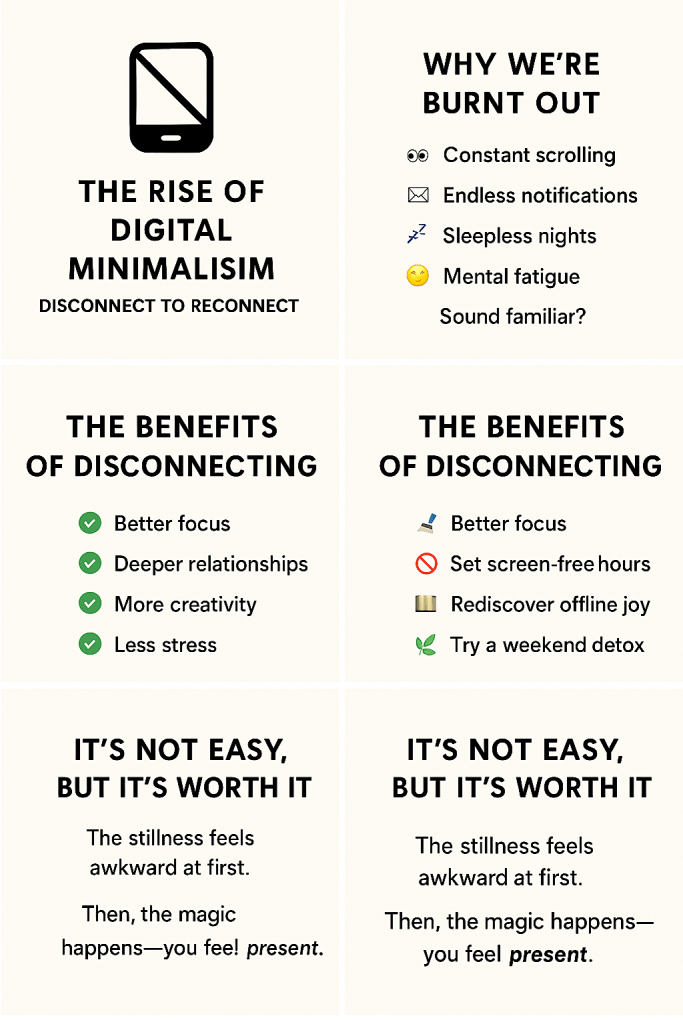
The Rise of Digital Minimalism: How Disconnecting Can Lead to More Meaningful Connections

Introduction:

Have you ever picked up your phone to check one thing, then looked up an hour later wondering where the time went? You’re not alone. In a world where our lives are filtered through screens, digital minimalism is gaining traction as a movement to reclaim our time, minds, and relationships.

What Is Digital Minimalism?

Digital minimalism isn’t about ditching technology altogether. It’s about being intentional with your screen time—using tech as a tool rather than letting it control you. Coined by author Cal Newport, it promotes quality over quantity in digital consumption.

Think:

  • Fewer apps
  • Less mindless scrolling
  • More focus on what matters

Why We’re Craving Less Screen Time

Many people are waking up to the emotional cost of being always connected:

  • Rising anxiety and burnout
  • Decreased attention span
  • Shallow online relationships replacing deep, real-life connections

We’re longing for the stillness and clarity that used to be part of everyday life—and digital minimalism is the path back.

The Benefits of Disconnecting

Going minimalist with your tech habits can spark powerful changes:
Improved mental clarity and focus
Deeper relationships (you’re truly present)
Better sleep and reduced stress
More time for creativity, hobbies, and goals

5 Practical Ways to Embrace Digital Minimalism

  1. Audit your apps. Remove any that don’t serve your purpose or joy.
  2. Set screen-free hours. (Example: no phones after 8 PM.)
  3. Use tech with intention. Ask: “Is this helping me or distracting me?”
  4. Rediscover analog joys. Read a book. Journal. Take a walk.
  5. Go on a digital detox weekend. Experience a full reset.

Real Talk: It’s Not Easy—But It’s Worth It

At first, the silence might feel uncomfortable. But then, something shifts. You start noticing things—the sound of birds, the taste of your food, the way your loved ones smile when you actually look up.

Digital minimalism isn’t just about less tech. It’s about more life.

In a society obsessed with connection, maybe the greatest rebellion is intentional disconnection. Try it—not to reject the digital world, but to reclaim your real one.

🧘‍♀️ Ready to try digital minimalism? Share your first step in the comments or tag me on your favorite platform (we are @therisingmuse everywhere) after your digital detox! #DigitalMinimalistChallenge

Somebody’s Gotta Do It – And We’re Grateful They Do

Let’s be honest: everyone thinks their job is hard.

And sometimes—it is. Emails are piling up. Meetings that could’ve been voice notes. A passive-aggressive coworker with too much cologne and not enough boundaries.

But this week on Thrive by The Rising Muse, we’re shining the spotlight on the folks who take “hard job” to a whole new level.

We’re talking about:
🧻 Portable toilet cleaners
🪦 Morticians
🩺 Nurses and OB-GYNs
🧪 Specimen collectors
🦨 Roadkill retrieval crews
😷 Vomit collectors (yes, that’s a real job)

Some of these jobs are disgusting. Some are emotionally draining. Some are dangerous. All of them are essential.

And yet, these workers rarely get recognized. They rarely get thanked. And they almost never go viral for doing the thankless, messy, behind-the-scenes labor that makes the rest of our lives run smoothly.

This Episode Is a Thank You Letter

In this episode, Naty and Veda take you through:

  • The wildest jobs you didn’t know were real (and probably couldn’t handle for five minutes)
  • The emotional and spiritual toll of caring professions like teaching, nursing, and mortuary science
  • The difference between performance gratitude and true, prayerful appreciation
  • Why we believe these roles are more than jobs—they’re callings

And above all, we talk about gratitude—the layered kind.
Gratitude for the people doing the hard, dirty, or emotionally intense work.
Gratitude that we don’t have to do it.
And gratitude to God for designing a world where we’re not all asked to carry the same burdens.

Why This Matters

It’s easy to get tunnel vision with your own stress. But stepping back and recognizing the invisible labor around us is an act of maturity—and worship.

That janitor in your office building?
That flight attendant is trying to stay calm at 30,000 feet?
Is that livestock breeder keeping the food supply running?
They’re not “less than.” They’re vital.

And if we want to grow, to really thrive, we’ve got to practice seeing the sacred in what the world sees as low.

Tune In Now

🎧 Episode: Somebody’s Gotta Do It
📍 Available wherever you get your podcasts
💬 Join the conversation on IG, TikTok, and Fanbase

This one will have you laughing, cringing, reflecting, and praying—and that’s exactly the point.


Need help? Know someone who does?
Mental health crisis: Dial 988
Domestic violence support: Call 800-799-7233 or text 887888
Always make sure you’re safe when seeking support.

Memorial Day: Reflection, Family, and Faith

This weekend, many of us will gather with family and friends, grateful for the pause and the unofficial start of summer. There will be laughter, shared meals, and the simple joy of togetherness. But as we embrace these moments of peace, it’s essential to hold space for the profound reason we are given this day: to remember the brave men and women who made the ultimate sacrifice for our freedoms.

Memorial Day is a day of solemn remembrance. It’s a day to honor those who laid down their lives in service to our nation. For many, this is not a day of celebration but one of quiet reflection, of visiting cemeteries, and of honoring the empty chair at the family table. It’s a powerful reminder that our peace was purchased at a great price.

At The Rising Muse, we believe in the convergence of faith, mental health, family, and personal growth. On Memorial Day, these pillars of our community are poignantly intertwined.

Faith in Sorrow

For families of the fallen, faith can be both a sanctuary and a struggle. The loss of a loved one can test the very foundations of what we believe. Yet, it is often in these moments of profound grief that faith can offer a glimmer of hope—a belief in a peace that surpasses all understanding and a reunion beyond this life. This Memorial Day, let us hold in our hearts the Gold Star Families, who walk a journey of faith and resilience that most of us will never know. Let us pray for their comfort and their strength.

The Weight of Remembrance and Our Mental Health

Grief is a heavy burden, and for military families, it is a unique and often lifelong journey. The quiet respect we show on Memorial Day is a testament to our collective acknowledgment of their loss. It is a way of saying, “Your loved one is not forgotten. Their sacrifice matters.”

Honoring this day with intention is also an act of communal mental well-being. It allows us to connect with a sense of gratitude and to understand the cost of the freedoms we often take for granted. By taking a moment for silent reflection or by participating in a memorial service, we create a space for collective healing and remembrance.

The Enduring Strength of Family

The families of our fallen heroes are a testament to the enduring strength of the human spirit. They carry on the legacy of their loved ones through their own lives of service, courage, and love. They are a vital part of our national family, and on this day, we have a sacred duty to remember them, to support them, and to honor the sacrifices they have also made.

Personal Growth Through Remembrance

How do we live a life that is worthy of such a great sacrifice? This is perhaps the most profound question Memorial Day asks of us. It calls us to a higher purpose in our own lives. It challenges us to be better citizens, kinder neighbors, and more engaged members of our communities.

Let this Memorial Day be a catalyst for your personal growth. Reflect on the freedoms you have and consider how you can use them to make a positive impact. Perhaps it’s by volunteering, by having meaningful conversations with your children about the cost of freedom, or by simply living with a greater sense of purpose and gratitude.

This Memorial Day, as you gather with your loved ones, we invite you to join us at The Rising Muse in a moment of quiet reflection. Let us remember the fallen, honor their families, and commit to living lives that are a testament to their enduring sacrifice.

May we never forget.

Trusting God or Telling Him What to Do? A Heart Check for Believers

We say we trust God. We quote Proverbs 3:5–6:
“Trust in the Lord with all your heart and lean not on your own understanding; in all your ways acknowledge him, and he will make your paths straight.”
But if we’re honest, many of us are doing more leaning on our understanding than we admit. We often try to sit in God’s chair, crafting our own plans, and then asking Him to rubber-stamp them with His blessing.

How often do our prayers sound less like surrender and more like strategy meetings?

“God, Let Me In on the Plan.”

Many of us live like we’re entitled to God’s full blueprint. We forget that faith, by definition, involves the unseen (Hebrews 11:1).
We say, “I trust You,” but then we beg for full disclosure:

“Lord, show me exactly what You’re doing, when You’re doing it, and how it will all turn out.”

But God doesn’t always offer that level of detail—not because He’s withholding, but because He’s cultivating trust. Isaiah 55:8–9 reminds us:
“‘For my thoughts are not your thoughts, neither are your ways my ways,’ declares the Lord. ‘As the heavens are higher than the earth, so are my ways higher than your ways and my thoughts than your thoughts.’”

Faith doesn’t require all the details. It requires trust in the One who holds them.

“God, Let Me Take the Wheel.”

Sometimes, we take action first and pray later, when the consequences catch up. We might even spiritualize it:

“I’m stepping out in faith.”
But were we really? Or were we stepping out in impatience?

Abraham and Sarah tried to “help” God by orchestrating a plan to fulfill His promise through Hagar (Genesis 16). The result? Generational strife. God’s promises don’t need human manipulation. They need patient trust.

“God, Bless My Mess.”

Even when we’ve gone our own way, God is merciful. But how often do we expect Him to bless decisions made without Him?

James 4:13–15 cautions us against presumption:
“Now listen, you who say, ‘Today or tomorrow we will go to this or that city…’ Why, you do not even know what will happen tomorrow… Instead, you ought to say, ‘If it is the Lord’s will, we will live and do this or that.’”

Inviting God into our plans after they’ve failed isn’t the same as surrender. It’s triage. He may still redeem, but it’s far better to build with Him from the start.

Real Trust Looks Like Surrender

Trust is not passive—it’s deeply active. It looks like praying before deciding, seeking God’s heart before our own will, and obeying even when the path is unclear.

Psalm 37:5 puts it simply:
“Commit your way to the Lord; trust in him, and he will act.”

Let’s stop trying to get God on board with our plans. Let’s get on board with His.

Finding Joy in the Everyday: A Faithful Perspective

Big achievements get all the attention. Graduations, promotions, weddings — they’re celebrated loudly. But the quiet truth is that real happiness often lives in the small, almost forgettable moments. A good cup of coffee. A random text from a friend. The way sunlight spills across the kitchen floor in the morning.

“This is the day the Lord has made; let us rejoice and be glad in it.” (Psalm 118:24)

We spend so much time chasing major milestones that we miss the everyday wins. We rush through breakfast thinking about the next deadline. We zone out during conversations because our minds are already five steps ahead. Meanwhile, life is happening in the background, quietly offering small joys to anyone paying attention.

Noticing these moments takes intention. It’s about slowing down, even briefly. It’s pausing to appreciate the rhythm of rain against the window or the smell of fresh laundry. It’s hearing your favorite song at the grocery store and actually letting yourself smile.

“Do not despise these small beginnings, for the Lord rejoices to see the work begin.” (Zechariah 4:10)

Gratitude is part of it, sure, but it’s more than that. It’s a mindset shift: choosing to see your daily life as enough, rather than a waiting room for something “better” to happen.

“Rejoice always, pray continually, give thanks in all circumstances; for this is God’s will for you in Christ Jesus.” (1 Thessalonians 5:16-18)

Start small. Put your phone down when you’re eating. Watch how your dog greets you like you’re the best part of its day. Laugh at a bad joke. Feel the weight of a cozy blanket. These moments won’t make headlines, but they build a quiet, lasting happiness that’s hard to shake.

Joy isn’t hidden in some grand future. It’s scattered all over your ordinary day, waiting to be noticed.

From Candy to Calling: What to Do Now That Easter is Over

The eggs have been hunted, the candy wrappers tossed, and the “He is Risen” banners packed away. Now what?

Too often, we treat Easter like the end of a spiritual season, when really—it should ignite the start of something new. At Thrive by The Rising Muse, we’re challenging ourselves (and you!) to let Easter be the spark that pushes us into action, healing, and deeper faith.

Here are 5 things you can do now that Easter is behind us:

  1. Reflect intentionally – Journal what moved you this season. What did God speak into your spirit?
  2. Reconnect with community – Whether it’s church, a podcast, or a small group, don’t isolate.
  3. Reignite your devotional life – Start a fresh plan or return to a forgotten one.
  4. Release guilt – If Easter came with tension, grief, or comparison, let it go. God’s grace is bigger.
  5. Renew your joy – It’s okay to celebrate. It’s okay to laugh. Jesus didn’t rise so we could live burdened.

Easter might be one day on the calendar, but resurrection life is every day we choose faith, grace, and love.

Keep rising, keep thriving, and keep showing up for your calling.


📲 Follow us @therisingmuse on IG, Threads, TikTok & Blue Sky
📡 Listen on wdjyfm.com (Thursdays 9AM), 99.1 FM ATL, 92.9 FM Denver, & Spiritual Channel 36 (Fairfax)

#ResurrectionEveryday #FaithOverFear #ChristianEncouragement #PurposeAfterEaster

After the Amen: Living the Resurrection Beyond Easter Sunday

Easter may be over, but the resurrection is far from finished.

The empty tomb wasn’t the end of the story—it was the beginning of a new life, a renewed purpose, and a reminder that hope always has the final word. But how do we carry the spiritual weight of Easter into our everyday routines?

If Easter stirred something in you—peace, gratitude, conviction, or clarity—this is your invitation to keep the momentum going.

At Thrive by The Rising Muse, our Easter conversation wasn’t just about tradition—it was about transformation. It reminded us that you can hold the holiness of resurrection and the joy of spring in the same heart. That bunnies and baskets don’t erase the cross, but that Jesus still reigns above all.

As the pastel fades and the candy disappears, don’t let your faith retreat with it.

Here’s how you can live the resurrection this week:

  • Start your day with gratitude—for breath, for purpose, for grace.
  • Look for new life in unlikely places: your thoughts, your relationships, your faith.
  • Be kind. Be bold. Be a vessel of joy in someone else’s winter.

Because resurrection isn’t just a moment. It’s a movement.

💭 What’s one thing Easter reminded you of this year? Leave a comment—we’d love to hear.


📲 Follow us on social: @therisingmuse
🎙 Listen weekly or on the radio: www.wdjyfm.com | 99.1 FM (ATL) | 92.9 FM / 89.3 HD3 Denver | Channel 36 Fairfax Public Access

#PostEasterFaith #LivingTheResurrection #FaithInAction