Legalizing the Gospel

This may not be a popular topic, but here we go.

In the last decade or so, I have seen a movement of Christians trying to put laws in place according to what the Bible says we should or should not do. I am a follower of Jesus, but this movement, in my opinion, has brought out several issues.

1. Politicians who pretend to be Christian just to obtain votes.
The Bible says, “You will recognize them by their fruits” (Matthew 7:16). However, in my observation, the masses are bending over backwards to justify some people’s behaviors, decisions, and actions just because their mouths have said they are Christians—even though their fruits are not showing.

2. Looking the other way.
I’ve also observed Christians compromising their own values just to have someone in office who will get things done the way they want, something like “the end justifies the means.”

Here’s my issue with Christianity by law: Are people realizing that forcing someone into a particular behavior does not mean they are accepting or living for Christ?

For example, you could mandate by law that all citizens attend church every Sunday. People might show up at their nearest church, but that doesn’t mean the message is going into their hearts.

God gave us free will. “Now the Lord is the Spirit, and where the Spirit of the Lord is, there is freedom” (2 Corinthians 3:17). Jesus never forced anyone to accept Him. Why are we? Jesus came to show us His unconditional love—a love that leads us to repentance and to fall in love with Him enough to follow Him to the ends of the earth.

When you force someone into submission, they don’t love what they’re doing—they resent it. They may outwardly show the “good” behavior you want to see, but their heart has not turned toward God.

Legislating Faith vs. Living Faith

Legislating faith is spiritual laziness. We are called to “go and make disciples of all nations” (Matthew 28:19), to witness what God has done in our lives, and to show His love through our actions. Instead, some want the government to force people to behave according to our beliefs so we can feel like we’ve accomplished something—when in reality, we have not.

We don’t want to do the hard work of loving everyone, forgiving everyone, and showing mercy to everyone. Instead, we often live with selective love for those who think, believe, and behave like we do. We exercise selective outrage toward those we judge, while ignoring the person in the mirror.

Should society be a free-for-all? No. But when we impose laws to force our faith on the masses, we are not pleasing God. We are not making disciples—we are making people who resent the gospel. And it’s not because of their hardened hearts, but because of our hypocrisy.

We appear hypocritical when we only address the sins of others but excuse the sins of those “within the faith.” “Why do you look at the speck in your brother’s eye and pay no attention to the plank in your own eye?” (Matthew 7:3).

When someone outside the church falls, we often respond with outrage. But when someone in our faith circle falls, we excuse it as a “moment of weakness.” That’s not mirroring Jesus—it’s hypocrisy.

The Call to Love

When someone doesn’t think like us, we dismiss them as evil, forgetting that God placed them in our path so we could witness to them and love them.

And yes, even love our enemies. “But I say to you, love your enemies and pray for those who persecute you” (Matthew 5:44).

So when I see people who claim to follow Christ spewing hate, it hurts my heart. Because we should know better. Did we forget where we were before Jesus rescued us? Did we forget that He forgave our sins—and continues to forgive them?

“For it is by grace you have been saved, through faith—and this is not from yourselves, it is the gift of God” (Ephesians 2:8-9).

If that’s true for us, then it is also true for those around us.

The Harvest Is Plentiful

The Word says, “The harvest is plentiful, but the laborers are few” (Luke 10:2). It is time to reflect on how our thoughts and behaviors are either drawing people to Jesus or pushing them away.

You may say you’ve tried and seen no results. But sometimes you’re only meant to plant the seed. Someone else waters, and another sees the fruit (1 Corinthians 3:6–7). But don’t miss your role as a planter.

I know it’s hard not to give up, but I can testify: I was a wreck, and God chased me relentlessly to show me His love. Even now, when I fall flat on my face, He picks me up, cleans me off, and sets me back on solid ground. He knows my flaws, yet He still uses me to reach people. He has assigned each of us to love and serve specific souls.

The Bottom Line

It is our job to show God’s love, grace, and mercy. It is not the government’s job to legislate Christianity, so we can feel good about forcing people into behaviors that don’t lead to salvation.

We don’t win souls by writing laws. We win them by living out the gospel.

#FaithOverPolitics #ChristianLiving #discipline

Trusting God or Telling Him What to Do? A Heart Check for Believers

We say we trust God. We quote Proverbs 3:5–6:
“Trust in the Lord with all your heart and lean not on your own understanding; in all your ways acknowledge him, and he will make your paths straight.”
But if we’re honest, many of us are doing more leaning on our understanding than we admit. We often try to sit in God’s chair, crafting our own plans, and then asking Him to rubber-stamp them with His blessing.

How often do our prayers sound less like surrender and more like strategy meetings?

“God, Let Me In on the Plan.”

Many of us live like we’re entitled to God’s full blueprint. We forget that faith, by definition, involves the unseen (Hebrews 11:1).
We say, “I trust You,” but then we beg for full disclosure:

“Lord, show me exactly what You’re doing, when You’re doing it, and how it will all turn out.”

But God doesn’t always offer that level of detail—not because He’s withholding, but because He’s cultivating trust. Isaiah 55:8–9 reminds us:
“‘For my thoughts are not your thoughts, neither are your ways my ways,’ declares the Lord. ‘As the heavens are higher than the earth, so are my ways higher than your ways and my thoughts than your thoughts.’”

Faith doesn’t require all the details. It requires trust in the One who holds them.

“God, Let Me Take the Wheel.”

Sometimes, we take action first and pray later, when the consequences catch up. We might even spiritualize it:

“I’m stepping out in faith.”
But were we really? Or were we stepping out in impatience?

Abraham and Sarah tried to “help” God by orchestrating a plan to fulfill His promise through Hagar (Genesis 16). The result? Generational strife. God’s promises don’t need human manipulation. They need patient trust.

“God, Bless My Mess.”

Even when we’ve gone our own way, God is merciful. But how often do we expect Him to bless decisions made without Him?

James 4:13–15 cautions us against presumption:
“Now listen, you who say, ‘Today or tomorrow we will go to this or that city…’ Why, you do not even know what will happen tomorrow… Instead, you ought to say, ‘If it is the Lord’s will, we will live and do this or that.’”

Inviting God into our plans after they’ve failed isn’t the same as surrender. It’s triage. He may still redeem, but it’s far better to build with Him from the start.

Real Trust Looks Like Surrender

Trust is not passive—it’s deeply active. It looks like praying before deciding, seeking God’s heart before our own will, and obeying even when the path is unclear.

Psalm 37:5 puts it simply:
“Commit your way to the Lord; trust in him, and he will act.”

Let’s stop trying to get God on board with our plans. Let’s get on board with His.

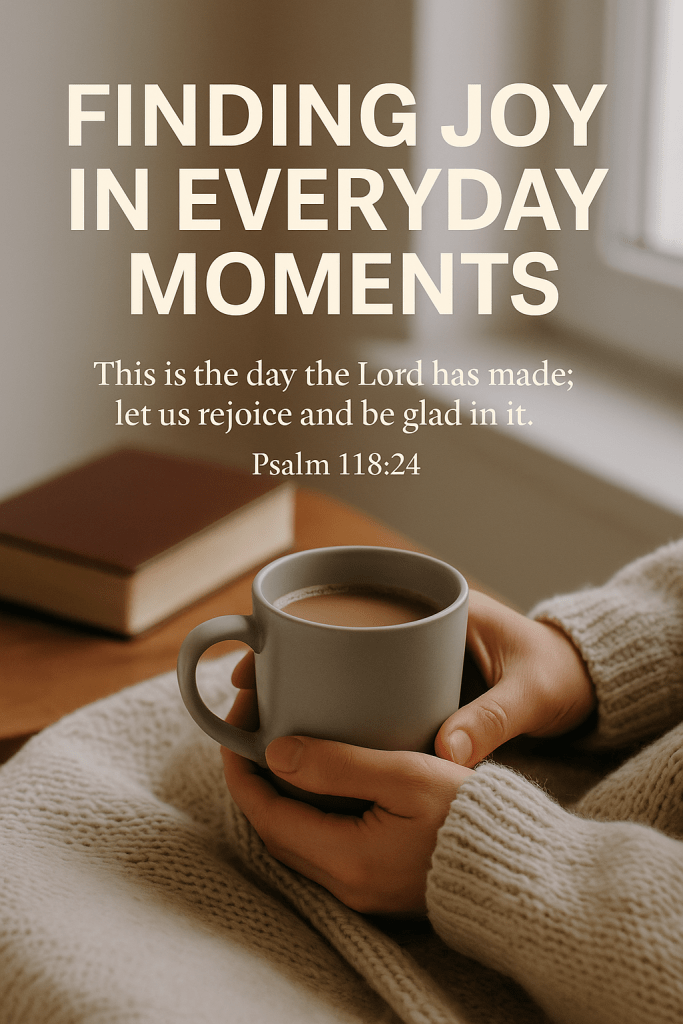
Finding Joy in the Everyday: A Faithful Perspective

Big achievements get all the attention. Graduations, promotions, weddings — they’re celebrated loudly. But the quiet truth is that real happiness often lives in the small, almost forgettable moments. A good cup of coffee. A random text from a friend. The way sunlight spills across the kitchen floor in the morning.

“This is the day the Lord has made; let us rejoice and be glad in it.” (Psalm 118:24)

We spend so much time chasing major milestones that we miss the everyday wins. We rush through breakfast thinking about the next deadline. We zone out during conversations because our minds are already five steps ahead. Meanwhile, life is happening in the background, quietly offering small joys to anyone paying attention.

Noticing these moments takes intention. It’s about slowing down, even briefly. It’s pausing to appreciate the rhythm of rain against the window or the smell of fresh laundry. It’s hearing your favorite song at the grocery store and actually letting yourself smile.

“Do not despise these small beginnings, for the Lord rejoices to see the work begin.” (Zechariah 4:10)

Gratitude is part of it, sure, but it’s more than that. It’s a mindset shift: choosing to see your daily life as enough, rather than a waiting room for something “better” to happen.

“Rejoice always, pray continually, give thanks in all circumstances; for this is God’s will for you in Christ Jesus.” (1 Thessalonians 5:16-18)

Start small. Put your phone down when you’re eating. Watch how your dog greets you like you’re the best part of its day. Laugh at a bad joke. Feel the weight of a cozy blanket. These moments won’t make headlines, but they build a quiet, lasting happiness that’s hard to shake.

Joy isn’t hidden in some grand future. It’s scattered all over your ordinary day, waiting to be noticed.

Living in the World but Not of It: A Call to Reflect Christ

In recent times, many Christians have been led to believe that we are called to impose our beliefs on the world by force, forgetting a fundamental truth of our faith: we are in this world, but we are not of it. This misunderstanding has led to behaviors and attitudes that run contrary to the teachings of Jesus. It’s like asking hotel management to remodel the room we’re renting temporarily. We’ve forgotten that this world is not our permanent home. As believers, our mission is not to change the world by worldly means but to point others to Christ so that their hearts can be transformed.

Jesus’ words in John 17:14-16 remind us of our place: “I have given them your word and the world has hated them, for they are not of the world any more than I am of the world. My prayer is not that you take them out of the world but that you protect them from the evil one. They are not of the world, even as I am not of it.” Our calling is to live as ambassadors of Christ, reflecting His love, grace, and truth while remembering that hatred, division, and force are tools of the enemy, who seeks to kill, deceive, and destroy (John 10:10).

The Mission We’ve Forgotten

The Great Commission calls us to make disciples, not to coerce others into belief. Jesus commands in Matthew 28:19-20, “Therefore go and make disciples of all nations, baptizing them in the name of the Father and of the Son and of the Holy Spirit, and teaching them to obey everything I have commanded you.” This mission requires patience, humility, and love. It’s not about forcing others to conform to our standards but about lovingly pointing them to the truth found in God’s Word.

Some have even gone so far as to attempt to manufacture events to hasten Jesus’ return. This is not only an act of pride but also selfishness. In Matthew 24:36, Jesus said, “But about that day or hour no one knows, not even the angels in heaven, nor the Son, but only the Father.” It is not our place to decide when Christ will return. Our focus should remain on the mission He has given us. If we truly love others as ourselves (Matthew 22:39), we will desire their salvation as much as we desired our own. Remember, someone shared the Gospel with us when we were lost. Let us not give up on others who have yet to know the truth.

Jesus Was Not a Political Figure

Many Christians today seem to forget that Jesus did not come to establish a political kingdom. He didn’t seek to change the laws of Rome or Jerusalem. Instead, He came to reveal the kingdom of heaven and to transform hearts. When we focus on imposing our beliefs through political or social power, we lose sight of the example Christ set for us.

In John 18:36, Jesus said, “My kingdom is not of this world. If it were, my servants would fight to prevent my arrest by the Jewish leaders. But now my kingdom is from another place.” This statement underscores the spiritual nature of His mission. Our task is not to make this world our home but to invite others to prepare for the kingdom of heaven.

Reflecting Christ’s Love

When we are unkind to those who are different from us, we’re not acting like Jesus. Loving the sinner while rejecting the sin is the delicate balance we’re called to maintain. Paul’s words in 1 Corinthians 13:4-7 provide a clear picture of what Christlike love looks like: “Love is patient, love is kind. It does not envy, it does not boast, it is not proud. It does not dishonor others, it is not self-seeking, it is not easily angered, it keeps no record of wrongs. Love does not delight in evil but rejoices with the truth. It always protects, always trusts, always hopes, always perseveres.”

Sadly, many unbelievers are turned away from Christ and His church not solely because of deception but because of the behavior of Christians that fails to reflect Christ. As John 13:34-35 says, “A new command I give you: Love one another. As I have loved you, so you must love one another. By this everyone will know that you are my disciples, if you love one another.” Love, not force, is the mark of true discipleship.

Staying Focused on Our Calling

As followers of Christ, our job is not to participate in the ways of the world but to preach the Word of God so that more people can be saved. Romans 12:2 reminds us, “Do not conform to the pattern of this world, but be transformed by the renewing of your mind. Then you will be able to test and approve what God’s will is—his good, pleasing and perfect will.” We cannot transform hearts—only God can do that. But we can live in a way that reflects His love, inviting others to experience His grace and truth.

The enemy seeks to sow division and hatred, but we are called to be instruments of peace. Let us remember our true mission: to share the Gospel, love others as Christ loves us, and reflect the kingdom of heaven in all we do. In doing so, we honor God and fulfill the purpose He has set before us.

Being Loving, Kind, and Merciful: Does Not Mean I’m a Doormat

As followers of Christ, we are called to embody love, kindness, and mercy. These attributes reflect God’s character and demonstrate His grace to the world. However, those with a tender heart may face challenges, including being taken for granted or used. How can we balance showing mercy with guarding our hearts?

The Call to Love, Kindness, and Mercy

Jesus set the ultimate example of love, kindness, and mercy. In Matthew 5:7, He says, “Blessed are the merciful, for they will be shown mercy.” Reflecting on the call to clothe ourselves with compassion, Colossians 3:12-14 reminds us: “Therefore, as God’s chosen people, holy and dearly loved, clothe yourselves with compassion, kindness, humility, gentleness, and patience. Bear with each other and forgive one another… And over all these virtues put on love, which binds them all together in perfect unity.” Living this way reflects Christ’s love and draws others to Him. Yet, we must also walk in wisdom, as Jesus instructs in Matthew 10:16: “Be as shrewd as snakes and as innocent as doves.”

Avoiding Being Taken for Granted

  1. Set Healthy Boundaries: Loving others doesn’t mean allowing them to misuse your kindness. Jesus Himself set boundaries, withdrawing to pray and rest when needed (Luke 5:16). He invites us to find rest for our souls in Him, saying in Matthew 11:28-30, “Come to me, all you who are weary and burdened, and I will give you rest.”
  2. Discern Motives: Pray for discernment to recognize when someone genuinely needs help versus taking advantage of your kindness. Philippians 1:9-10 says, “And this is my prayer: that your love may abound more and more in knowledge and depth of insight, so that you may be able to discern what is best.”
  3. Speak the Truth in Love: When necessary, confront those who misuse your kindness with gentleness and respect. Ephesians 4:15 urges us to speak the truth in love, ensuring we build others up. As Proverbs 27:6 states, “Wounds from a friend can be trusted, but an enemy multiplies kisses.”
  4. Rely on God’s Strength: Acts of mercy must flow from God’s love, not human approval. Galatians 6:9 encourages us, “Let us not become weary in doing good, for at the proper time we will reap a harvest if we do not give up.” Depend on God’s Spirit, as Zechariah 4:6 reminds us, “Not by might nor by power, but by my Spirit,’ says the Lord Almighty.”

Trusting God as Your Defender

Even when others misunderstand or misuse your kindness, take heart in knowing that God sees your heart. Psalm 62:6 declares, “Truly he is my rock and my salvation; he is my fortress, I will not be shaken.” Rest in His promise from Exodus 14:14: “The Lord will fight for you; you need only to be still.” Trust Him to vindicate you and provide the strength to continue loving others.

In all things, let Jesus’ words in John 13:34-35 guide you: “A new command I give you: Love one another. As I have loved you, so you must love one another. By this everyone will know that you are my disciples, if you love one another.” As you navigate the balance of kindness and boundaries, let your actions glorify God, reflect His love, and steward the gifts He has entrusted to you.

Where Is Your Faith?

In recent years, there has been a noticeable shift as many people choose to leave their churches or distance themselves from their faith. This trend often stems from negative experiences within their religious communities or deep disappointment in religious leaders who have been found guilty of despicable acts. These situations beg a crucial question: where is your faith placed? Is it in God or in the fallible humans who lead religious congregations?

It’s essential to acknowledge that religious leaders, despite their higher calling, are still human beings. They possess the same weaknesses and capacity for wrongdoing as anyone else. The Bible reminds us in Psalm 118:8, “It is better to take refuge in the Lord than to trust in humans.” This verse emphasizes that placing our faith solely in human beings is fraught with risks. Humans can fail, disappoint, and lead us astray, but God remains constant and unchanging.

When a religious leader falls from grace, the impact on their congregation can be profound. Feelings of betrayal and disillusionment are natural. However, it is critical to remember that these leaders are not the foundation of our faith. Jeremiah 17:5-7 states, “Thus says the Lord: ‘Cursed is the man who trusts in man and makes flesh his strength, whose heart turns away from the Lord. Blessed is the man who trusts in the Lord, whose trust is the Lord.’” These verses highlight the dangers of placing our ultimate trust in people rather than in God.

The Bible consistently directs us to place our faith in God, not in humans. Hebrews 12:2 advises, “fixing our eyes on Jesus, the pioneer and perfecter of faith.” This guidance is crucial, particularly in times of disappointment and disillusionment. When our faith is firmly rooted in God, we can withstand the storms that arise from human failure and sin.

It is beneficial for each of us to reflect on the foundation of our faith. Are we more invested in the personalities and actions of our religious leaders than in God Himself? Matthew 7:24-27 tells the parable of the wise and foolish builders, emphasizing the importance of building our spiritual foundation on the solid rock of God’s teachings rather than on the shifting sands of human behavior.

For those feeling disheartened by the actions of others within their religious community, take heart. Use this opportunity to refocus and realign your faith. Galatians 6:9 encourages us, “And let us not grow weary of doing good, for in due season we will reap, if we do not give up.” Persistence in faith, despite human failings, will ultimately lead to spiritual growth and fulfillment.

As we navigate the complexities of faith within religious communities, it is vital to continually examine our hearts and ensure that our faith remains anchored in God. Reflect on where your faith is placed and recognize when it may have been affected by misplaced trust. By keeping our eyes fixed on God, we can find strength, resilience, and true peace, even amidst human imperfections.

In the end, let us remember the words of Proverbs 3:5-6: “Trust in the Lord with all your heart, and do not lean on your own understanding. In all your ways acknowledge him, and he will make straight your paths.” This scripture is a timeless reminder to trust in God above all else and to find our security and direction in Him alone.

Until next time, stay blessed.

Remember to check out our Youtube Channel

Deepening Our Roots in Faith and Life

In the ebb and flow of daily life, where the hustle often overshadows our spiritual needs, the “Thrive” podcast stands as a beacon for those seeking to ground themselves in faith. As part of our ongoing promotional campaign, we’re excited to shine a spotlight on how “Thrive” continues to offer guidance, inspiration, and a sense of community for listeners navigating the intersections of Christianity, mental health, parenting, family, and women’s issues. This platform is not just a podcast; it’s a journey towards spiritual enrichment and personal growth.

Nurturing Faith at Home

“Thrive” dives deep into the heart of faith-based parenting, emphasizing the critical role of introducing our children to God’s teachings from an early age. Beyond just the inclusion of faith-related books alongside academic ones, the podcast underscores the importance of living out the tenets of our faith in our daily lives. It’s about setting an example—showing our children the power of prayer, the strength found in turning to God during difficult times, and the impact of a personal relationship with Jesus witnessed through our actions.

Living the Teachings of Jesus

Each episode of “Thrive” is a treasure trove of wisdom on how to embody kindness, forgiveness, and empathy, just as Jesus did. The podcast offers strategies for parents eager to arm their children with Biblical wisdom to face today’s cultural challenges head-on, all while maintaining a foundation built on biblical principles. From engaging in acts of kindness to teaching gratitude and establishing a dialogue about faith within the safety of home, “Thrive” serves as your guide in fostering a nurturing, faith-filled environment.

A Family’s Spiritual Journey

“Thrive” champions the concept of spirituality as a collective journey, encouraging practices such as attending church as a family, engaging in regular prayer, and making Scripture reading a part of daily life. These shared experiences not only strengthen the family bond but also instill profound spiritual truths in children from a young age. Furthermore, the podcast discusses the significance of prayer in parenting, suggesting practical tools like prayer journals to keep families aligned with their faith goals.

Join the “Thrive” Community

As we continue to unfold the layers of integrating faith with the complexities of modern living, “Thrive” invites you to become part of a growing community that seeks to live a life reflective of their faith. This podcast is your companion in navigating the challenges and joys of parenting, mental health, and personal growth through a Christian lens.

Remember Thrive launches on April 7th and will be available on your favorite podcast platform. Take a step towards a life where faith and daily living intertwine seamlessly. Together, let’s embrace the journey of thriving in faith, hope, and love, one episode at a time. You can also subscribe to our Youtube channel, where the video version of Thrive will be housed.

Join us, as we explore the depth of living a spiritually enriched life that not only seeks understanding but also puts faith into action. Let’s not just navigate life; let’s thrive in it, with every story, every teaching, and every conversation guiding us closer to the heart of what it means to live fully in faith.

Until next time, take care and God bless.

Faith in Action: The Power of Everyday Acts of Kindness

In a world often overwhelmed by grand gestures and larger-than-life displays of faith, it’s easy to forget the profound impact that small acts of kindness can have on our spiritual journey. While we are saved by grace and not by works, our transformed faith should manifest in the daily choices we make. As the saying goes, faith without works is dead, and sometimes it’s the little things that speak volumes about the state of our hearts.

Here are some examples of acts of kindness we can practice in our daily lives:

1. Picking Up After Yourself:
At a restaurant, it may seem insignificant to clean up after yourself, especially when there are staff members assigned for that task. However, taking a moment to clear your table not only lightens their load but also reflects a consideration for those who work tirelessly in the service industry. This simple act exemplifies humility and selflessness, mirroring the teachings of Christ.
Luke 22:26 (ESV) – “But not so with you. Rather, let the greatest among you become as the youngest, and the leader as one who serves.”

2. Starting the Coffee:
In the morning rush at home or the office, being the one to start the coffee can be a small yet impactful gesture. Even if you don’t drink coffee yourself, the act of preparing it for others demonstrates a selfless attitude and a willingness to serve without expecting anything in return.
Philippians 2:4 (NIV) – “Each of you should look not only to your own interests but also to the interests of others.”

3. Sharing the Sale:
When you come across a sale or a buy-one-get-one-free offer, consider sharing the extra item with someone in need. This could be a struggling family or a neighbor facing financial challenges. Such generosity not only helps others practically but also opens the door for meaningful conversations or anonymous acts of kindness.
1 John 3:17 (NLT) – “If someone has enough money to live well and sees a brother or sister in need but shows no compassion—how can God’s love be in that person?”

4. Volunteering Without Recognition:
Being the one who consistently volunteers to help, even if it goes unnoticed or unappreciated by others, is a powerful way to put your faith into action. Remember, you are not working for the acknowledgment of people but for the Lord, and your humble service reflects the heart of Christ.
Colossians 3:23-24 (NIV) – “Whatever you do, work at it with all your heart, as working for the Lord, not for human masters, since you know that you will receive an inheritance from the Lord as a reward. It is the Lord Christ you are serving.”

Engaging in these small acts of kindness on a daily basis is not just about making the world a better place; it’s also a means of deepening our spiritual journey. These actions serve as tangible expressions of our faith, helping us die to ourselves and become more Christlike. By imitating Christ in our daily lives, we learn to love sacrificially, putting the needs of others before our own.

In the grand tapestry of our spiritual journey, the threads of everyday acts of kindness weave a story of love, humility, and selflessness. While the kingdom of God certainly encompasses grand missions and transformative projects, it is equally built on the foundation of small, consistent acts of love and service. So, as you embark on your faith journey, remember that it’s not always about the magnitude of your actions but the sincerity and love behind them. If you’re looking for a way to kickstart your faith in action, consider taking the Act of Kindness Challenge , in the “15 Day Challenge to a Stronger YOU“, and witness the transformation in yourself as you strive towards a stronger, more compassionate you.

Come Forth!

I was thinking about how we get complacent in our walk with Christ. It is very easy to live in the routine of Christian Living. You get up, if you are well disciplined you do your prayers and start your daily routine.

Once the day ends once again you do your daily prayers and you go to bed. Some come home tired and stay like zombies watching television for hours until they pass out or they drag themselves to bed and don’t even remember to reflect on the challenges and blessings of the day.

Once a week you go to church, and you pray that the preacher is not too inspired otherwise it’s going to take more time than usual. God forbid there’s a guest speaker, they usually talk even longer.

Have you lost your passion? Have you moved away from your first love, from Jesus?

Why do we lose that passion? We can blame it on many things; the routine, the extra work that your boss has put on your plate, the unruly children, that person at the church who annoys the ever living out of you. If you take a step back, aren’t those just excuses?

God woke you up today and gave you 24 hours out of love. What are you going to do with that time? Wasn’t the whole point of being “saved” and born again to get rid of religion and have a relationship with God?  What areas of your life are dead?

As I was thinking about this, I remember the scriptures regarding Lazarus’s resurrection.

Jesus said to her, “Did I not say to you that if you would believe you would see the glory of God?”41 Then they took away the stone from the place where the dead man was lying.[a] And Jesus lifted up His eyes and said, “Father, I thank You that You have heard Me. 42 And I know that You always hear Me, but because of the people who are standing by I said this, that they may believe that You sent Me.” 43 Now when He had said these things, He cried with a loud voice, “Lazarus, come forth! (John 11:40-43)

Who or what is your Lazarus? What is keeping you from being once again on fire for the love of Christ? It’s time to remove the stone, believe in the One that God sent and come forth!

Until then, be blessed

clip_image002

In Growth Lessons, I was reminded of this beautiful truth: Our walk with the Lord is a process of growing up into the image of Christ. P. Yates

I would recommend this book for anyone who would like some common sense and light added to their life. C. Cunningham

Great for meditations and daily devotions. N. Thames