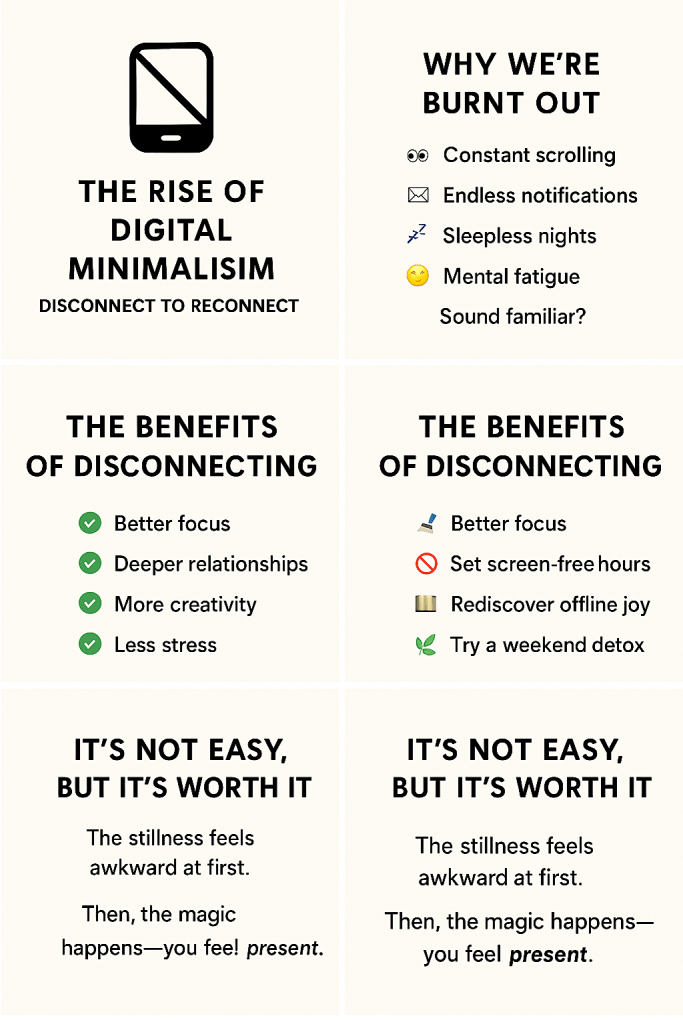
The Rise of Digital Minimalism: How Disconnecting Can Lead to More Meaningful Connections

Introduction:

Have you ever picked up your phone to check one thing, then looked up an hour later wondering where the time went? You’re not alone. In a world where our lives are filtered through screens, digital minimalism is gaining traction as a movement to reclaim our time, minds, and relationships.

What Is Digital Minimalism?

Digital minimalism isn’t about ditching technology altogether. It’s about being intentional with your screen time—using tech as a tool rather than letting it control you. Coined by author Cal Newport, it promotes quality over quantity in digital consumption.

Think:

  • Fewer apps
  • Less mindless scrolling
  • More focus on what matters

Why We’re Craving Less Screen Time

Many people are waking up to the emotional cost of being always connected:

  • Rising anxiety and burnout
  • Decreased attention span
  • Shallow online relationships replacing deep, real-life connections

We’re longing for the stillness and clarity that used to be part of everyday life—and digital minimalism is the path back.

The Benefits of Disconnecting

Going minimalist with your tech habits can spark powerful changes:
Improved mental clarity and focus
Deeper relationships (you’re truly present)
Better sleep and reduced stress
More time for creativity, hobbies, and goals

5 Practical Ways to Embrace Digital Minimalism

  1. Audit your apps. Remove any that don’t serve your purpose or joy.
  2. Set screen-free hours. (Example: no phones after 8 PM.)
  3. Use tech with intention. Ask: “Is this helping me or distracting me?”
  4. Rediscover analog joys. Read a book. Journal. Take a walk.
  5. Go on a digital detox weekend. Experience a full reset.

Real Talk: It’s Not Easy—But It’s Worth It

At first, the silence might feel uncomfortable. But then, something shifts. You start noticing things—the sound of birds, the taste of your food, the way your loved ones smile when you actually look up.

Digital minimalism isn’t just about less tech. It’s about more life.

In a society obsessed with connection, maybe the greatest rebellion is intentional disconnection. Try it—not to reject the digital world, but to reclaim your real one.

🧘‍♀️ Ready to try digital minimalism? Share your first step in the comments or tag me on your favorite platform (we are @therisingmuse everywhere) after your digital detox! #DigitalMinimalistChallenge

Meaningful Decisions This New Year

Self-care and meaningful resolutions often dominate the conversation as the new year begins. But 2025 must be different. Life has shown us that “business as usual” is no longer acceptable. We can’t keep making promises to ourselves only to abandon them within weeks. This year demands resolutions that reflect the urgency of our times—resolutions that bring us peace, fulfillment, and connection. Here are five true resolutions to embrace in 2025:

1. Tell Those Around You That You Love Them

As of January 17, 2025, more than 40 lives have been tragically lost in major events, including 25 in the California fires, five in last weekend’s winter storms, and 15 in the Louisiana terrorist attack. This doesn’t even account for the countless others lost to accidents, illnesses, and age. Each of these numbers represents families who didn’t get one last word with their loved ones.

This year, let’s make it a priority to express our love—not just in words but in actions. Send that text, make that call, or give that hug. As Proverbs 27:1 reminds us, “Do not boast about tomorrow, for you do not know what a day may bring.” Cherish the moments you have now.

2. Make Amends and Forgive

Life is unpredictable, and holding onto anger only weighs us down. If amends need to be made, take the first step. If reconnecting isn’t safe or advisable, you can still forgive in your heart. Forgiveness isn’t about the other person; it’s about releasing yourself from bitterness. As Ephesians 4:32 says, “Be kind to one another, tenderhearted, forgiving one another, as God in Christ forgave you.” Let this year be one of emotional freedom.

3. Start a Form of Minimalism

We’re surrounded by clutter—both physical and emotional. If you don’t need it, don’t buy it. A helpful tip shared by a guest on The Rising Muse podcast is to leave items in your cart for 24 hours before deciding to purchase. You’ll be amazed at how many “needs” turn out to be unnecessary.

For me, this year’s purchases will focus on essentials like groceries, gas, and clothes for my growing child. As Ecclesiastes 5:10 warns, “Whoever loves money never has enough; whoever loves wealth is never satisfied with their income.” Let’s aim for simplicity, contentment, and intentional living.

4. Learn a New Survival Skill

Our dependence on technology can leave us unprepared for even minor disruptions. Consider learning basic survival skills: sewing a button, fixing a tire, or preparing a meal without electricity. This isn’t about doomsday prepping; it’s about practicality. Proverbs 22:3 offers wisdom: “The prudent see danger and take refuge, but the simple keep going and pay the penalty.” Being prepared is an act of wisdom and stewardship.

5. Prioritize Health

You don’t need a gym membership to get moving. Walk around your neighborhood, dance to your favorite playlist, or play actively with your kids. Just give your body the movement it craves. In 1 Corinthians 6:19-20, we’re reminded, “Your body is a temple of the Holy Spirit within you… glorify God in your body.” Small, consistent efforts can have a big impact.

Watch What Goes Into Your Body

This isn’t about restrictive diets. Instead, focus on small, manageable changes. Drink more water, cut back on fried foods, or reduce sugar intake. And don’t forget to feed your spirit. Are you praying or meditating? Protect your peace by avoiding content and environments that disturb your mood. Philippians 4:8 encourages us to dwell on what is true, noble, and praiseworthy.

6. Purge Your Social Life

Are you attending events out of obligation rather than joy? Are there relationships that bring more stress than peace? This year, embrace the power of “no.” As Ecclesiastes 3:1 reminds us, “There is a time for everything, and a season for every activity under the heavens.” Prioritize what truly matters and let go of what doesn’t serve you.

7. Pick a New Hobby

Try something new. It doesn’t have to be big or expensive. If you have the time and interest, it could be as simple as reading a certain number of books or experimenting with a new recipe each week. Look for free activities to enjoy on your days off at least once a month. Even something as small as getting crayons and a coloring book can bring joy and relaxation. Exploring a new hobby can bring fulfillment and add a spark of creativity to your life.

Final Thoughts

These resolutions aren’t about radical changes or impossible goals. They’re small, intentional steps that lead to a less stressful, more fulfilling life. As Psalm 90:12 prays, “Teach us to number our days, that we may gain a heart of wisdom.” Let’s make 2025 the year we live with purpose, connection, and peace.

Creating Intentional New Year Goals Rooted in Faith

As the year draws to a close, many of us begin thinking about resolutions and goals for the new year. It’s a time to reflect on where we’ve been and where we hope to go. However, as believers, our goals don’t just stem from personal desires—they are an opportunity to align our plans with God’s purpose for our lives.

Instead of focusing solely on external achievements, we can create Christ-centered goals that promote spiritual growth, strengthen our relationships, and honor God in every area of our lives. Let’s explore how to set intentional New Year goals rooted in faith.

1. Begin with Prayer

Before setting any goals, start with prayer. Ask God to guide you in reflecting on the past year and discerning His will for the year ahead. Invite Him into your planning process so your goals are aligned with His plans.

Prayer Prompts:

  • What lessons did God teach me this year?
  • Where is God calling me to grow?
  • How can I better serve Him and others?

Scriptural Reminder:
“If any of you lacks wisdom, you should ask God, who gives generously to all without finding fault, and it will be given to you.” (James 1:5)

2. Reflect on Your Spiritual Journey

As you set goals, take time to evaluate your walk with Christ. Are there areas where you’d like to grow deeper in your faith? Perhaps you want to spend more time in prayer, read through the Bible, or become more active in serving others.

Consider goals that nurture your relationship with God, such as:

  • Establishing a daily quiet time.
  • Memorizing Scripture.
  • Joining a small group or Bible study.
  • Journaling prayers and answers.

Scriptural Reminder:
“But grow in the grace and knowledge of our Lord and Savior Jesus Christ. To him be glory both now and forever! Amen.” (2 Peter 3:18)

3. Set Goals That Glorify God

When creating goals, focus on how they can bring glory to God. Whether your goals are personal, professional, or relational, they should reflect your desire to honor Him.

Examples of Christ-centered goals:

  • Building healthier habits to honor your body as God’s temple (1 Corinthians 6:19-20).
  • Strengthening your marriage or family relationships through intentional time together.
  • Using your talents and skills to serve in your church or community.
  • Managing your finances according to biblical principles.

Scriptural Reminder:
“So whether you eat or drink or whatever you do, do it all for the glory of God.” (1 Corinthians 10:31)

4. Be Specific and Measurable

God is a God of order and intentionality, and our goals should reflect that. Vague goals can leave us feeling overwhelmed, but specific, measurable objectives give us direction.

For example:

  • Instead of “pray more,” set a goal to “pray for 15 minutes each morning.”
  • Instead of “read the Bible,” aim to “read through the New Testament by June.”
  • Instead of “serve others,” plan to “volunteer monthly at a local shelter.”

Scriptural Reminder:
“The plans of the diligent lead to profit as surely as haste leads to poverty.” (Proverbs 21:5)

5. Balance Personal Growth with Serving Others

While self-improvement is valuable, our ultimate calling is to love and serve others. Consider setting goals that prioritize generosity, kindness, and community.

Ideas for outward-focused goals:

  • Start mentoring someone in your church or workplace.
  • Organize a monthly outreach with friends or family.
  • Commit to praying for specific individuals or causes each week.

Scriptural Reminder:
“Do not merely look out for your own personal interests, but also for the interests of others.” (Philippians 2:4)

6. Trust God with the Outcome

While it’s important to plan, remember that God’s plans are always greater than our own. Some goals may unfold differently than expected, and that’s okay. Trusting Him means surrendering our goals to His will and being open to His redirection.

Scriptural Reminder:
“In their hearts, humans plan their course, but the Lord establishes their steps.” (Proverbs 16:9)

7. Stay Accountable and Celebrate Progress

Share your goals with trusted friends or family members who can encourage and hold you accountable. Celebrate the small victories along the way, remembering that every step of growth is worth acknowledging.

Encouragement Tip: Keep a journal to track how God works through your goals. Looking back on His faithfulness will inspire gratitude and perseverance.

Final Thoughts: A Year with Purpose

As you step into the new year, let your goals reflect your faith and trust in God. Whether big or small, each intentional step can bring you closer to Him and help you live out His purpose for your life.

Closing Scripture:
“Commit to the Lord whatever you do, and he will establish your plans.” (Proverbs 16:3)

Let’s approach this new year with hope, purpose, and a heart ready to follow where God leads.

Happy 2025!